SACAA Withdrawal AJC 18.28 notice.
Early Bird Specials - Oshkosh 2027.
The AirVenture story is also a numbers game.
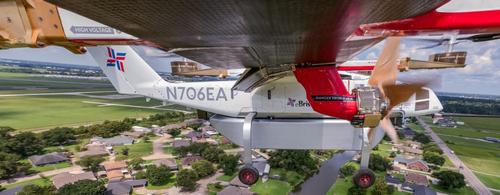
Robinson unmanned R44 Airtruck demonstrates offshore cargo capabilities at Acadiana Regional Airport in Louisiana.
Elroy Air completes the first uncrewed autonomous flights under U.S. DOT and FAA's eVTOL Integration Pilot Program.
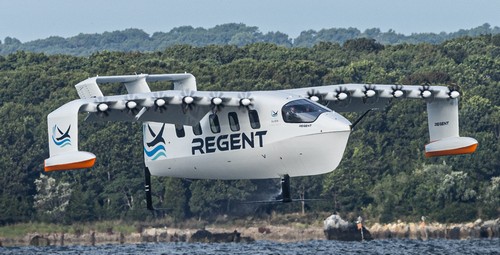
The future of maritime mobility takes flight: Regent announces world's first human-crewed Seaglider flight.
Archer's 'No Roads' tour takes off by completing Midnight's piloted roundtrip flight from Salinas to Hollister.
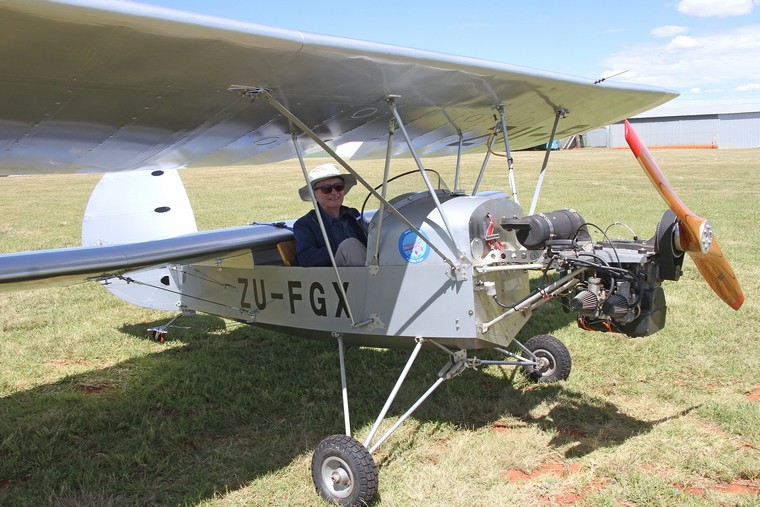
This week in history - The Flying Flea is a large family of light homebuilt aircraft first flown in 1933.
Worldwide Incidents and Accidents
Bonus video - tlas Impala Mk I SAAF Trainer & ground Attack Aircraft
SACAA Withdrawal AJC 18.28 notice
www.caa.co.za legal-notices-2
Notice of Intention to Withdraw AIC 18.28; General Notice relating to CAR 91.09.2 read together with SA. The South African Civil Aviation Authority (SACAA) has officially published a Notice of Intention to Withdraw AIC 18.28. This notice addresses historical provisions relating to an operator's Quality Control System.
Summary of AIC 18.28 and the Notice
What is AIC 18.28? Originally issued in 2004, this Aeronautical Information Circular provided guidance and text amendments regarding the "Quality Control System" under paragraphs 2.1.4 of CATS 121.04.2, 127.04.2, and 135.04.2.
The Reason for Withdrawal: The SACAA is systematically cleaning up outdated circulars that point to older or heavily modified frameworks, steering operators instead to stick directly to current Civil Aviation Regulations (CARs) and Technical Standards (CATS).
Comment Deadline: The official window for industry stakeholders and operators to submit comments on this proposed withdrawal closes on 30 September 2026.
What this Means for Aviation Operators
If you are an AOC holder under Part 121, 127, or 135, you should plan for the following impacts:
Audit Manuals: Quality Managers and Accountable Managers must check their Operations Manuals and Quality Manuals for any explicit references to AIC 18.28. Once the circular is officially finalized as withdrawn, those manuals will need updating to reference current, promulgated CARs/CATS provisions.
Part 127 Specific Concerns: Industry legal analysts (such as Aviation4SA) have flagged that while Parts 121 and 135 have parallel modern regulatory amendments in place, the replacement SA-CATS 127 provisions are not yet fully promulgated. The industry consensus is pushing for SACAA to delay the formal withdrawal for Part 127 operators until those replacements are legally effective.
AirVenture Oshkosh 2027
Take advantage of our Early Bird Specials!
Bookings are open for our 2027 AirVenture Camping Tour to Oshkosh, the world's BIGGEST aviation celebration! Good news is that, as in previous years, we are offering Early Bird Specials on all our tour options - for those wanting to take advantage of a 7.5% discount on the total tour price - by booking and paying up front - please contact Neil at info@airadventure.co.za or cell +27 84 674 5674
Offer expires 27 September 2026
Alpha Tour (ex Johannesburg)
Sharing R41 655 (Early Bird R38 530)
Single R43 900 (Early Bird R40 607)
Bravo Tour (ex Durban)
Sharing R42 680 (Early Bird R39 479)
Single R44 950 (Early Bird R41 578)
Charlie Tour (ex Cape Town)
Sharing R43 350 (Early Bird R40 098)
Single R45 350 (Early Bird R41 948)
Delta Tour (ex Chicago)
Sharing R14 950 (Early Bird R13 828)
Single R17 250 (Early Bird R15 956)
* Please note prices are subject to change should exchange rates or tariffs vary
FOR 2026 TOUR INFO - Got to www.airadventure.co.za/oshkosh-tours.html
Our team will be present at EAA Sun 'n Fun 2026, Krugersdorp, 24 to 27 September - if you're planning on going to Oshkosh, or you're a past visitor, we'd love to see you!
Every year, AirVenture writes its own story over a weeklong period at Oshkosh. By the time it's finished, it's fair to say that story is big as an encyclopedia.
One measure of that are the more than 65,000 words written by the AirVenture Today team over eight issues of the daily newspaper distributed on the grounds on July 19-26. That is approximately the same number of words that goes into an average best-selling novel. It also accounted for 62,000 copies of the paper, or 3,312,000 pages.
Those are just a few of the odd and interesting numbers collected during The World's Greatest Aviation Celebration. While some of the major statistics were released shortly after the event ended, number geeks (like us) enjoy some of the others…
One of the fun post-AirVenture games is watching how long members wear their wristbands before they remove it or it just disintegrates. But, if we took everyone's wristband when they departed and laid those bands end-to-end, it would stretch for 113 miles…
The Operation Thirst volunteers made 18,632 sandwiches to feed the other volunteers on the grounds…
A total of 1,381 people ran, walked, or sauntered in the Runway 5K run/walk on July 25, accounting for 4,281 total miles or approximately the straight-line air distance between Atlanta and London (each of which, during AirVenture week, have international airports less busy than Wittman Regional Airport)…
The EAA Aviation Museum welcomed 38,000 visitors during the week - roughly one-third of its total annual attendance…
Along with all the airplanes and people arriving by bus, shuttle, and motorhome, EAA teams parked more than 68,400 cars in our lots during the week, nearly 6,000 more than in 2025. That encompassed 15,800 vehicles parked on July 25, including 7,400 between 11 a.m. and 2 p.m. alone! …
A team of volunteers at the Print/Mail Center hand-assembled more than 30,000 buttons that were distributed by various EAA groups during the week…
And finally: 1 - As in one tremendous week that brought together the world of flight like no place else on earth. And in one year, we'll be ready to do it again (July 26-August 1, 2027)
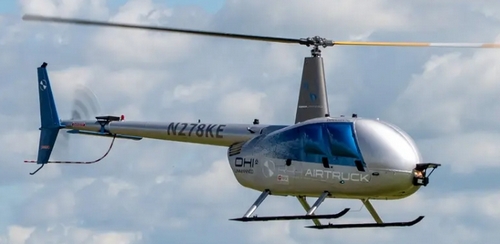
Robinson Unmanned R44 Airtruck Demonstrates Offshore Cargo Capabilities at Acadiana Regional Airport in Louisiana
The Robinson Unmanned R44 AIRTRUCK, an unmanned, remotely piloted cargo helicopter recently completed a series of demonstration flights at Acadiana Regional Airport (KARA) in New Iberia, LA. The flights were conducted September 2 and 3 by Aviation Academy of Louisiana (AAL), an authorized Robinson dealer and service center, with PHI Aviation and invited industry, government, and observers in attendance.
Over two days, the aircraft demonstrated operational readiness for offshore missions, including cargo loading and unloading, elevated deck landing, precision positioning, and airspace integration, flying repeated approaches to a platform configured as an offshore deck. It operated with a crew of two: one remote pilot in command and one ground support crew, showing the efficient operating footprint of the system.
The R44 AIRTRUCK is built on the Robinson R44 airframe, the world's most-produced helicopter platform, and adapted for remotely piloted operation using Rotor Technologies' RPX unmanned flight system. It carries a useful load of up to 1,000 pounds and more than 60 cubic feet of internal volume, cruises at over 100 knots, and operates up to 14,000 feet.
Louisiana has supplied the offshore energy industry for generations, and the missions that keep platforms running, resupply, crew logistics, deck work, are not only demanding, but weather-exposed, and unforgiving. An unmanned aircraft like the R44 AIRTRUCK that can land on a deck, carry a real load, and be maintained at a field site offers operators a way to move cargo more effectively. Last week's test flights let local operators see for themselves how remotely piloted operations also improve safety, putting the aircraft, not people, in the highest-risk part of the mission.
The demonstration reflects Robinson's "Era of Both" approach, which gives operators the option to choose the appropriate technology for a specific mission type. Because the R44 AIRTRUCK is built on a proven, certified airframe, it is supported by the same people, parts, and procedures as Robinson's manned fleet. The New Iberia flights put that shared support model to work in a real-world field environment.
"This is the Era of Both in practice, the same airframe, the same parts, and the same people supporting manned or unmanned missions," said David Smith, president and CEO of Robinson Helicopter Company. "Offshore operators have spent decades moving crews and cargo to platforms in some of the toughest flying conditions there are. When you build an unmanned aircraft on a proven helicopter, they don't trade away reliability to gain autonomy. They get both, and they get to send the aircraft, not the crew, on the highest-risk legs offshore without giving up the load or the capability they have come to count on from Robinson."
Elroy Air Completes the First uncrewed Autonomous Flights under U.S. DOT and FAA's Evtol Integration Pilot Program
Elroy Air, a U.S.-based technology developer of autonomous heavy-cargo drones for commercial logistics, defense and rapid response, today announced the completion of the first autonomous and uncrewed flights authorized under the U.S. Department of Transportation's (USDOT) and the Federal Aviation Administration's (FAA) eVTOL Integration Pilot Program (eIPP). This marks a historic moment on the way to nationwide commercial autonomous cargo operations.
Elroy Air's Chaparral, an autonomous hybrid-electric VTOL aircraft capable of carrying more than 500 lbs of payload with a maximum range of up to 450 miles, conducted a week-long series of flights in Houma, Louisiana in late August. The flights were completed in partnership with LIFTOFF Louisiana and long-time partner Bristow Group, demonstrating Chaparral's readiness for commercial service across the Gulf Coast's energy and industrial corridors across Louisiana, Texas and Mississippi. A variety of cargo was transported during the week including packages and parcels, medical supplies, toolboxes with spare parts, food and jerry cans of water. Elroy Air was selected for the eIPP in March 2026 as part of the State of Louisiana's application and Chaparral remains the only purpose-built, heavy-payload cargo drone in the program.
“Over the course of the week, Chaparral flew autonomously and with no pilot on board from one of the nation's busiest airports for rotorcraft under Air Traffic Control oversight. These flights bring Chaparral closer to fulfilling our mission: moving heavy cargo autonomously, safely, and at scale for commercial operations,” said Elroy Air CEO Dr. Andrew Clare. "Through the eIPP, we're working closely with the FAA as well as local and state officials to shape how uncrewed cargo aircraft operate in the National Airspace System. We're grateful to Bristow Group, LIFTOFF Louisiana, and the FAA for their partnership, and to the White House, Secretary Duffy, and the USDOT for their commitment to American aviation leadership.”
The eIPP was established under President Trump's Unleashing American Drone Dominance Executive Order to accelerate the safe integration of Advanced Air Mobility aircraft into the National Airspace System. The program brings together aircraft manufacturers, operators, state and local governments, and federal agencies, with operational data informing future aviation policy and the broader commercialization of Advanced Air Mobility across the United States.
“I witnessed Chaparral fly at Houma-Terrebonne Airport under air traffic control. It was a disciplined, safe operation-and exactly the kind of work this program is meant to produce,” said Josh Duplantis, Advanced Aeronautics Director at the Louisiana Department of Transportation and Development. “We are proud of this first week with Elroy Air and Bristow Group, and we are ready for the work still ahead under LIFTOff Louisiana.”
“This demonstration with the Louisiana Department of Transportation and Development and Elroy Air provides data to help turn these concepts from trial to deployment.” said FAA Administrator Bryan Bedford. “These test flights demonstrate how these new aircraft can expand cargo delivery options to communities nationwide and improve our logistics infrastructure.”
"Our energy and government services customers need low-risk, high-tempo options for moving critical cargo across the Gulf Coast, and that's exactly what Chaparral delivers," said Dave Stepanek, Bristow Executive Vice President and Chief Transformation Officer. "Louisiana is our core U.S. base of operations, and these flights bring us closer to offering our customers new ways to move freight offshore and across the region."
While Chaparral's eIPP flights are focused on commercial operations, its dual-use design extends to defense logistics, tactical resupply and humanitarian aid. Elroy Air's commercial demand pipeline exceeds 1,400 aircraft, representing more than $5 billion in potential revenue from leading logistics and aviation companies. Kratos Defense & Security Solutions, the exclusive U.S. manufacturer of the Chaparral, will produce the aircraft at its expanding Sacramento, California facility, with the first production aircraft planned for late 2026.
The Future of Maritime Mobility Takes Flight: REGENT Announces World's First Human-Crewed Seaglider Flight
In a world-first, REGENT Craft's Seaglider™ vessel prototype, Viceroy, has successfully completed its first human-crewed flight, making it the largest-ever all-electric wing-in-ground effect (WIG) craft to fly with people on board. The flight marks the first time a wing-in-ground effect vessel has been engineered and readied for commercial and defense operation at scale - solidifying America's leadership in ground effect flight and positioning REGENT as the pioneer of this transformative transportation technology.
The first flight took place at REGENT's headquarters on Narragansett Bay, R.I., with a crew of two captains aboard. The Seaglider flew a distance of 1,956 ft (596 m) at a height of 33 ft (10m) above the water for 30 seconds.
The Viceroy prototype flight test provides critical validation of the innovative technology and marks the start of the program's final stage of sea trials. The REGENT team spent the summer increasing the vessel's hydrofoiling speed in preparation for the flight, part of a comprehensive testing effort throughout 2026 spanning both on-water operations and simulation-based development. These efforts continue to refine vehicle performance, de-risk operations, and accelerate REGENT's readiness for commercial service and defense applications. REGENT has previously demonstrated flight of its uncrewed Squire Seaglider drone.
Seaglider vessels are high-speed, hydrofoiling wing-in-ground effect (WIG) craft that combine the speed of an aircraft with the convenience of a boat. The vessel operates in three modes - float, foil, and fly - starting on its hull at low speed, transitioning to hydrofoils once clear of the dock, and then taking flight within one wingspan of the water's surface.
Hydrofoiling gives Seaglider wave tolerance and maneuverability in harbors and near coastlines. A triple-redundant digital control system manages stability autonomously, so even in flight, the captain drives the Seaglider like a boat: left, right, fast, and slow. The digital control system offers a level of safety and control that no WIG craft has achieved before it.
The Viceroy vessel will be able to fly at speeds up to 180 mph for up to 180 miles, and seat 12 passengers and two crew. Onboard, passengers can expect ample legroom, large windows, and a quiet ride - all while traveling faster than a ferry and skipping the delays of airport-style check-in.
Archer's 'No Roads' Tour takes off by Completing Midnight's Piloted Roundtrip Flight from Salinas to Hollister
Archer completes the first stop on the company's 'No Roads' flight tour with a city-to-city roundtrip flight between Salinas and Hollister, CA.
Midnight completed the round trip between Salinas Municipal Airport and Hollister Municipal Airport in roughly 12 minutes each way, which by comparison can each take ~40 minutes or more by car. The all-electric aircraft reached speeds of 125 mph, cruised at 3,550 feet, and covered over 40 miles roundtrip.
The flight comes days after Archer launched its plans for its 'No Roads' flight tour and follows a stretch of more than 70 completed test flights in August, including Midnight's piloted roundtrip journey between Salinas Municipal Airport and Monterey Regional Airport.
The tour is now set to continue in the coming weeks across Northern California with planned flights to Monterey, San Martin, San Jose, Oakland and San Francisco. Working closely with the FAA and state and local partners, this series of flights set the stage for Midnight to then begin flying in the Los Angeles area and conducting operations under the White House's eVTOL Integration Pilot Program (eIPP) in Texas, Florida and New York.
"On Friday, Midnight flew between two California communities in a fraction of the time the trip would take by car. That's the point of the 'No Roads' tour: bring Midnight to cities across America, fly real routes, and build the operational muscle for eIPP operations and LA28 alongside the FAA. Every route we fly makes the next one easier. By the time the world comes to LA for the Games, people will be ready for it,” said Adam Goldstein, Founder and CEO of Archer.
Archer's goal with its Midnight aircraft is to transform urban travel, replacing 60-90 minute commutes with quiet, all-electric flights that dramatically reduce travel times compared to traditional ground transportation. Archer's all-electric Midnight air taxi is designed around the urban air mobility use case with the ability to conduct rapid back-to-back flights with zero operating emissions.
a href="http://www.bathawk.co.za" TITLE="Click here for more information" target="_blank">
10 September 1933
The Flying Flea (French: Pou du Ciel, lit. 'Louse of the Sky') is a large family of light homebuilt aircraft first flown in 1933.
The odd name comes from the French nickname for the Ford Model T automobile: Pou de la Route, or "Louse of the Road", because Henry Ford's economy car was so common. Henri Mignet dreamed of creating a Model T of the air, an airplane for the common man, hence the term Pou du Ciel. In English, the term became Flying Flea. Originally applied only to the HM.14 model, the name has now come to describe the family of aircraft of similar configuration designed by Mignet and others
Italy, Milan Malpensa Airport (MXP/LIMC): An easyJet Airbus A320 (reg. OE-IVS) operating flight U23905 to Prague was evacuated during taxi at Milan Malpensa Airport after a small fire was reported in the cabin, caused by an overheating power bank inside a passenger's hand luggage. Emergency slides were used to evacuate all 146 occupants. Two passengers sustained minor injuries while exiting the aircraft.
Malaysia, Long Lellang STOLport (WBGF), Long Lellang, Sarawak: A MBB Bo 105CBS-5 helicopter, 9M-LLF, experienced an engine fire approaching Long Lellang (Sarawak), trailing smoke, and crashed short of runway 04 at Long Lellang STOLport (WBGF), Long Lellang. The five occupants perished and the helicopter was destroyed by fire. The helicopter was reportedly operating on the Miri-Ba Lai-Long Siut-Long Lellang route, conducting medical visits.