Boeing's Innovative AMST the Short-lived YC-14
By Willie Bodenstein
05.09.206
Google Banner Ad
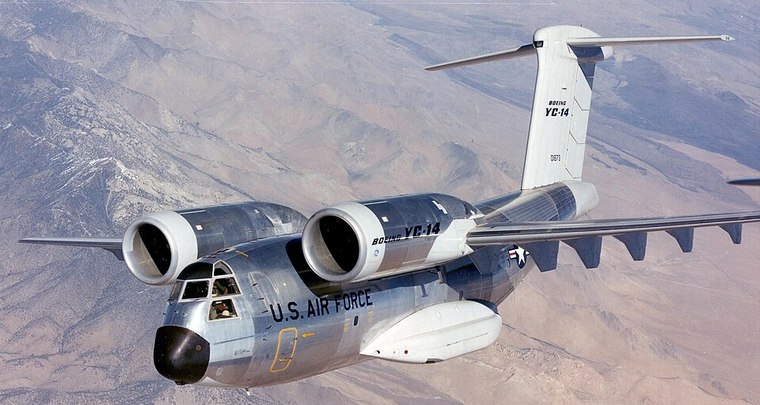
In the 1970's, the USA was still very much involved in Vietnam War operating the Lockheed C-130 Hercules as the USAF's standard STOL tactical transport that then required about 4,000 ft (1,200 m) with a 27,000 lb (12,000 kg) payload in both directions with no refuelling.
Most airfields at that time fell well short of this, most being semi prepared fields of approximately 2,000-foot (610 m) which with similar weights could not be used by the C130.
The government of the day initiated a study by the Tactical Aircraft Investigation (TAI), with Boeing, McDonnell Douglas, and other companies to look at possible tactical transport aircraft designs. This study was a precursor to what became the Advanced Medium STOL Transport program the AMST.
Five companies including Boeing and McDonnell Douglas submitted designs. Both were selected for the development of two prototypes each. Boeing's the YC-14 had its first flight on 9 August 1976. McDonnell Douglass's YC-15 had its first flight almost a year earlier.
Head-to-head flight of the two models testing started in early November 1976. During flight testing, the YC-14 was flown at speeds as low as 59 kn (68 mph; 109 km/h) and as high as Mach 0.78 at 38,000 feet (11,600 m). It was capable of taking off and landing in a distance of 800 ft (240 m). During the testing the YC-14 also demonstrated the capability to carry the 109,200-pound (49,500 kg) M60A2 main battle tank. This capability was not matched by the YC-15.
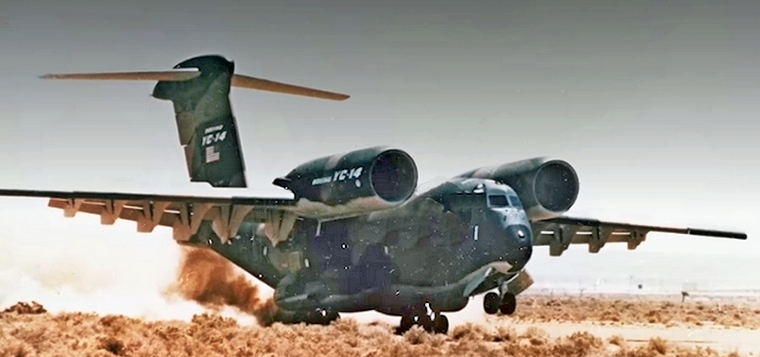
Both the YC-14 and YC-15 met or exceeded the AMST specifications under most conditions. However, as so often happen to the weapons of war during armed conflicts changing circumstances led to the end of the AMST program in December 1979.
In March 1976 the Air Force Systems Command was instructed to investigate the possibility develop a single model of the AMST for both strategic and tactical airlift roles, or alternatively, if it would be possible to develop conventional derivatives of the AMST for the strategic airlift role. This led to a series of studies that found that such modifications would require major changes to either design to produce a much larger aircraft.

The AMST project was ended in 1979 and replaced by the C-X program that later selected a proposal for an enlarged and upgraded YC-15. That development eventually led to the C-17 Globemaster III.
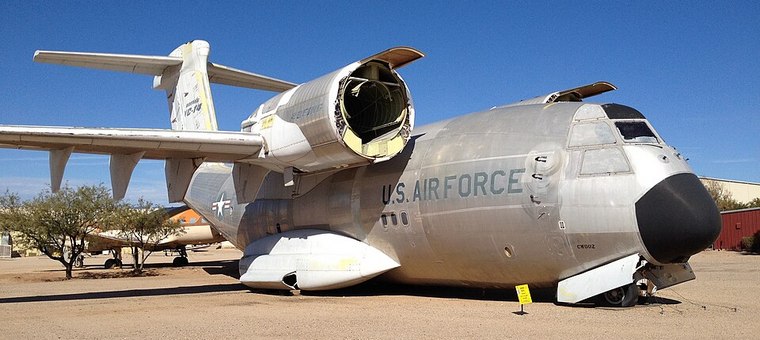
At the completion of testing in 1977, the YC-14 prototypes were returned to Boeing. Fortunately the prototypes were not scrapped; one is stored at the 309th Aerospace Maintenance and Regeneration Group (AMARG), located at Davis-Monthan Air Force Base and the other is on display at the nearby Pima Air & Space Museum.



<iframe width="760" height="480" src="https://www.youtube.com/embed/zrwhCT0IE38" title="Mach Loop Wales A Must Visit" frameborder="0" allow="accelerometer; autoplay; clipboard-write; encrypted-media; gyroscope; picture-in-picture; web-share" referrerpolicy="strict-origin-when-cross-origin" allowfullscreen>
Mach Loop Wales A Must Visit
318
Google Banner Ad
|
       |