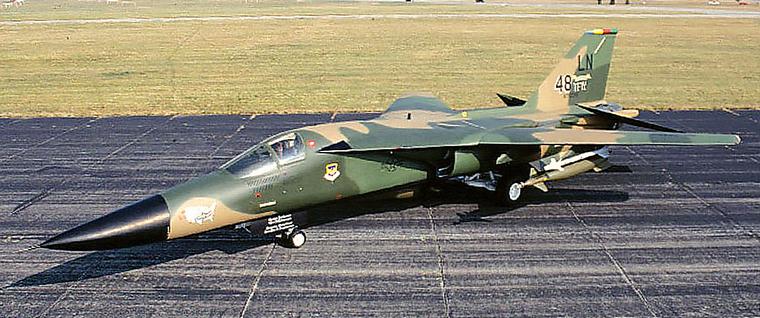
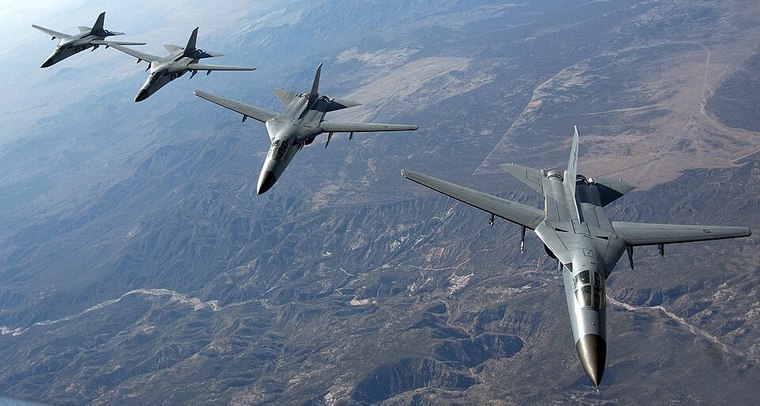
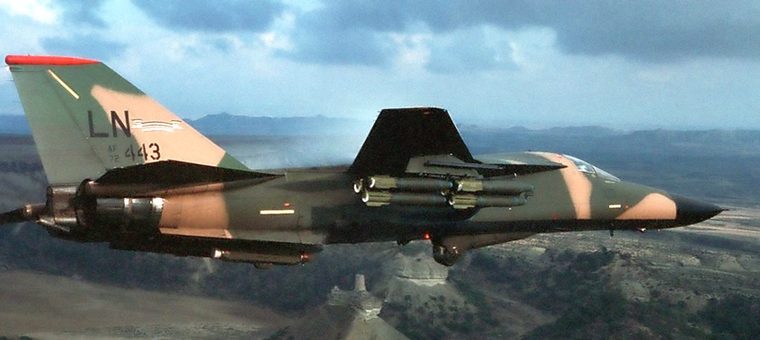
General Dynamics's F-111 Aardvark ground-attack strike aircraft
By Willie Bodenstein
22.07.2026
Google Banner Ad
I have, for as long as I can remember, been in love with aircraft. There is no other way to describe it. I read about them, build models, drew them, dreamed about them and treasured each sighting, which when I was young was rare. Growing up in a small Bushveld town in South Africa our local airfield housed only two aircraft, a Piper Cub and a Pawnee.
Over the years there has always been some aircraft that however seemed just be that bit more special than others and one of them was the General Dynamics F-111 Aardvark that successfully completed its 30-minute maiden flight at Carswell Air Force Base, Fort Worth, Texas on 13 July 1968. The same year when I successfully passed my driver's licence test having failed the first attempt for not having had my hands at the ten and two o'clock position on the steering wheel!
Why I liked the F-111 it is difficult to explain. Perhaps because it was called the Aardvark, an African animal with an elongated snout that it use to hunt for ants from their underground habitat. In my long life in Africa I have never ever seen a life Aardvark and neither have I seen its Mach 2.2 strike fighter namesake.
Making up for this I have had the honour of having met one of the pilots who flew this wonderful beast. T.C. Schultz is a retired United States Air Force Colonel and former F-111 Aardvark pilot who has made South Africa his home and is actively involved in the South African aviation community. He serves on the committee and as secretary of Chapter 973 of the Experimental Aircraft Association of South Africa (EAA of SA) based at Jack Taylor Airfield Chapter 973 Jack Taylor Airfield, Krugersdorp.
TC, as he is affectionally known by one all, whose lifelong passion for aviation began in childhood, flying with his father who served as a Marauder pilot in World War Two. Since earning his wings in 1972, TC has accumulated an impressive flying career, holding a Commercial Pilot's Licence with Instrument and Multi-Engine ratings and is a Certified Flight Instructor.
The F-111 was the first production aircraft with a variable sweep wing, a wing configuration that can be changed in flight. The wing provided outstanding aerodynamic efficiency. With wings fully extended, the F-111 could take off and land in as little as 2,000 feet. With wings fully swept back, it could reach supersonic speeds at high or low altitudes. At high altitudes, the F-111 could fly more than 2.2 times the speed of sound. At low altitudes, the F-111 could fly supersonic speeds hugging the ground with its terrain-following radar (TFR).
One Aardvark pilot described using the TFD at night as 'interesting”. “We engaged the TFR system and it pushed us over into a 10 degree dive until we were 5,000 feet above the ground, when the dive angle increased to 12 degrees before beginning to level off 1,000 feet above the set clearance plain (how high you wanted to fly above the ground, usually 1,000 feet). After levelling off at 1,000 feet, you could 'step down' to as low as 200 ft. The plane was capable of flying Mach 1.2 at 200 feet. However, for the most part, at night we flew at 1,000 feet, both as a safety margin and to not scare people and livestock on the ground. The beam width on the TFR radars was very narrow meaning flying down a canyon the wingtip clearance could be as small as 50 feet, which definitely made for some real excitement while the airplane is flying hands off.”
The USA then was heavily involved in the Vietnam war and during March 1968, not long after its introduction into service, Aardvark was deployed to conduct low-level, ground-attack missions, flying in excess of 4,000 combat missions while incurring only six combat losses completing 3.2 successful strike missions for every unsuccessful one, better than any other US strike aircraft used in the operation.
Expensive maintenance and budget cuts led to the original F-III's being withdrawn from service in the 1990's culminating in 1998. The Aardvark was replaced by the F-15E Strike Eagle in the medium-range, precision strike missions, while the supersonic bomber role has been assumed by the B-1B Lancer, both legends in their won lifetimes.
Maybe, one day during my regular visits to the world renowned Kruger National Park I may be lucky enough to see a real life Aardvark (Scientific name Orycteropus) historically referred to as antbears or Cape anteaters. However, I do think I have a better chance to see a real F111 Aardvark. There are quite a few survivors loving cared for in the National Museum of the US Air Force in Ohio, the Castle Air Museum in California, and the Fort Worth Aviation Museum in Texas. In Australia, the RAAF variant can be seen at the Queensland Air Museum.