If your business wants to connect directly with the most engaged and influential audience IN SOUTH AFRICAN aviation, there's no better platform than Pilot's Post Online Aviation.
Aero Club Communique #4 of 2026.
Mbambo honours SAAF units, bases and personnel at Prestige Parade.
Ethiopia acquires Yak-130 trainers, Orion-E UAVs from Russia.
Paramount provides humanitarian support to flood-affected communities in Mozambique.
Bristow signs launch agreement with Electra to secure first delivery slot for EL9 Aircraft.
Horizon Aircraft unveils key advances for full-scale Cavorite X7/
France orders Airbus VSR700 un-crewed aerial system.
Boeing: Indian, South Asian Airlines will need nearly 3,300 new airplanes by 2044.
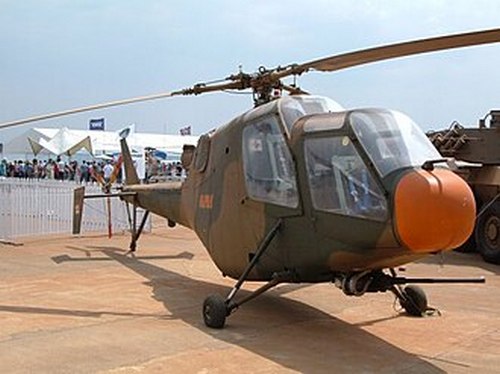
This week in history - First flight of the Atlas XH-1 Alpha, a South African prototype attack helicopter.
Worldwide Incidents and Accidents
Bonus video - AirVenture Oshkosh 2024 Heavy Metal at Boeing Plaza
If your Business Wants to Connect Directly With the Most Engaged and Influential Audience in South African Aviation, There's no Better Platform than Pilot's Post Online Aviation.
In 2024 alone, we published 48 Midweek Updates and 192 in-depth Sunday feature reports, keeping readers informed, inspired, and invested in the latest developments across the aviation world. We remain the only South African publication providing daily coverage from Oshkosh and most major UK airshows, giving our audience exclusive insights they can't find anywhere else.
Over the past 14 years, we've produced an unmatched 3,729 articles and reports, building a reputation for credibility, quality, and consistency that both readers and advertiser's trust. No other aviation publication in South Africa can rival our reach, depth, or engagement and none can offer better exposure at more affordable rates. Whether you're launching a new product, promoting a service,
or strengthening your brand presence, advertising with Pilot's Post ensures your message soars directly to the people who matter most in aviation.
Take your marketing to new heights-advertise with Pilot's Post and be part of South Africa's leading aviation voice.
Contact Willie on 082 442 8815 for a free no-obligation quote, and unbeatable value!
Aero Club Communique #4 of 2026
Hello to all our Aero Club members.
A resolution to the 12-year engine overhaul matter is taking shape given the many workgroup engagements we have had as Industry with the CAA. We have reviewed the proposed amendments to the Appendix 3 of the Technical Standards of Part 43.
There is a converging consensus among those who were involved with the process that the proposed Appendix is a well-researched and fit for purpose document, and we thank our members who participated for their hard work inputs. The proposal, when promulgated, will allow the general aviation owners, who adhere to the requirements of Appendix 3, to fly piston-engined type-certified aircraft that have exceeded the 12-year overhaul limit to continue flying with the engine on an on condition basis.
There is a meeting of the SACAA Aviation Safety Operations Sub-Committee on Monday the 3rd of February where at this meeting the proposal will most probably be tabled with a recommendation to the Civil Aviation Regulations Committee (CARCom) that the proposal be published for public comment. The Aero Club will support the motion that Appendix 3 be published for public comment.
Planning for the Aero Club Airweek 2026 is now well underway. An event like this requires the coordination of many aspects in its planning, given that it is a multidisciplinary event. The requirements are diverse and differ, amongst others, from adhering to statutory and legal requirements, the condition of the airside, runways and taxiways, electricity supply, availability of emergency fire and medical services to the availability of toilets.
The progress is going well, and the Middelburg Aero Club is starting to prepare the grounds for the arrivals now a month away.
If you have not yet registered, please access the link below. Also see the copy of the poster. We look forward to seeing many flyers together at Airweek. https://mailchi.mp/6792bb799348/aero-club-airweek-2026-is-coming-your-way-sign up-to-participate
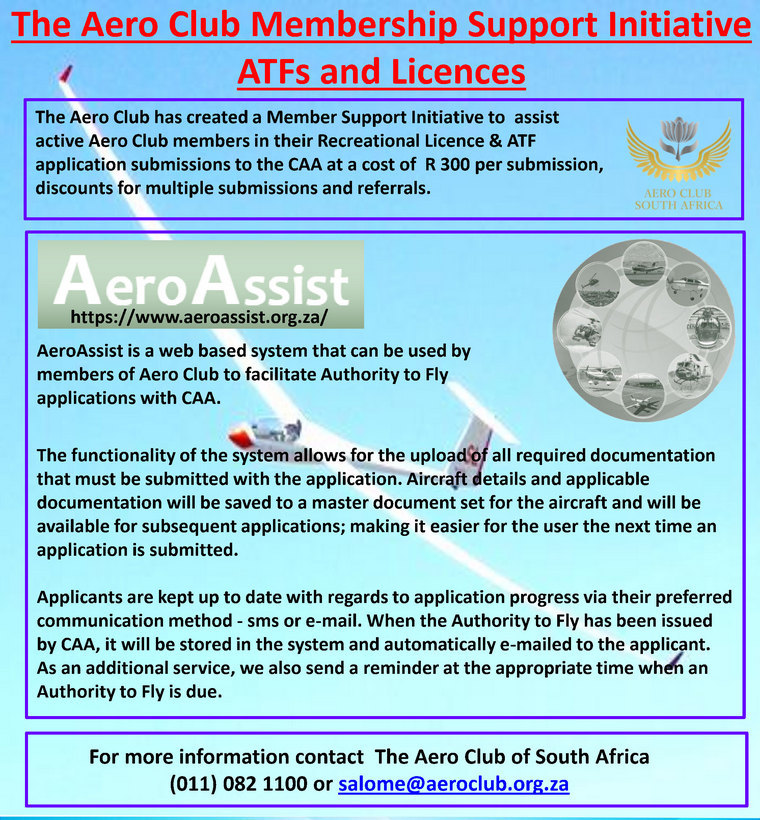
If you need to renew your Authority to Fly, see the information below about our Aero Assist system.
The 2026 Aero Club membership renewal commenced on the 1st of December.
Please visit the Aero Club website renewal portal at hip/ to renew or to register as a new member.
Have a good, safe week.
Regards
Walter Doubell
Acting Chairman, Aero club of SA walter@aeroclub.org.za
Mbambo Honours SAAF Units, Bases and Personnel at Prestige Parade
Guy Martin www.defenceweb.co.za
The South African Air Force (SAAF) has turned 106 years old, with the Chief of the SAAF, Lieutenant General Wiseman Mbambo, honouring all those who have safeguarded the country's skies over the last century, including those involved in recent disaster relief efforts.
January was a very busy month for the SAAF as it responded to multiple fires in the Western Cape, and flooding in Mpumalanga, Limpopo, and Mozambique. Around 800 people were rescued from rising flood waters in Mozambique, while SAAF A109 and Oryx helicopters continue to provide humanitarian assistance and deliver supplies there. In the Western Cape, Oryx helicopters were used to drop water onto fires in one of the worst fire seasons recorded in many decades.
“The recent floods and fires in the Western Cape province have seen us responding with what we have, professionally,” Mbambo told the Prestige Parade at SAAF Mobile Deployment Wing (formerly Air Force Base Swartkop) on Friday 30 January. “We have never failed to respond to the cry for help from our neighbours in Mozambique. Judging from the current change of climate and weather patterns, the rotary capability will be required more frequently than in the past.”
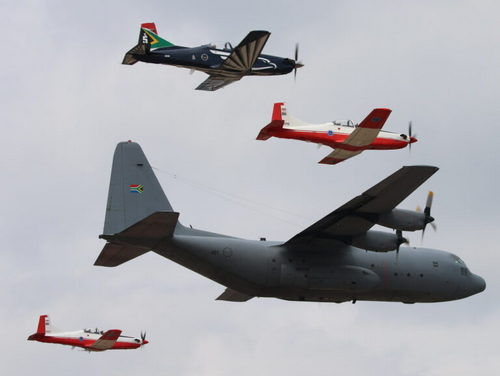
SAAF serviceability has been improving recently, and this was evident in the multiple helicopters being used for disaster relief, as well as the varied flypast lineup for Friday's parade. This included two Rooivalk attack helicopters, a BK117 light utility helicopter, a C-130BZ Hercules transport, two Cessna Caravans, a King Air, four PC-7 Mk II trainers, three Hawk Mk 120 Lead-In Fighter/Trainers, and two Falcon VIP jets.
Mbambo told DefenceWeb this was due to a combination of factors, including spares trickling in, and helicopters returning from the Democratic Republic of Congo after serving with the United Nations and Southern African Development Community missions there. Mbambo said additional spares are required to get more machines in the air, with the issue of spares being “really important.” A challenge in this regard is factors that are out of the SAAF's control such as conflict and disruption elsewhere in the world affecting the supply chain.
Mbambo said he was proud of what the men and women in the SAAF are able to do with what they have, and acknowledged that fighter, transport and rotary wing machines require attention at various levels. “It is important that we are prudent in the way we conduct our business from training, maintenance and operations perspectives. Collaboration with the local aerospace industry is fundamental and keeping relations with our international partners in the aerospace industry is also essential.”
“Technology in the local industry as well as in the international market to upgrade some of our systems is available. This will attend to the issues of obsolescence that require urgent attention. Furthermore, it will assist the SAAF to survive in the short to medium term while the funding matters are being addressed by those assigned for that responsibility,” Mbambo told the parade.
Modern threats evolving
The SAAF Chief told guests and military personnel that the Air Force's mandate has not changed but the challenges in the aerospace domain have increased exponentially, with adversaries undermining air borders “while we sleep” and advancing in the use of technology.
“The ease of access to modern technology today by those with evil intent has become a wicked problem for all militaries. Their advantage is embedded in their ability to make decisions quickly without any hindrance of bureaucracy and long winded processes. In this regard they are outpacing us with regard to access to simple but superior technology. The use of slow and low altitude unmanned aviation systems to gain access and violate our borderlines is a cause for concern,” Mbambo said.
Another concern for the Chief is the violation of South Africa's national space. “Those who are opposed to what we stand for as a state and country continuously pry on us and have critical data/information that can be used to counter everything we do.”
A long aviation history
Touching on the SAAF's history, Mbambo noted that Air Force Base Swartkop was established in 1921 and at 105 years old is the oldest operational base in the world. “We are compelled to keep this base operational because it is our historical site which future generations must be able to trace our past.”
Mbambo told the audience that the SAAF's history is intertwined with South Africa's history and must be preserved. “Our country's history cannot have missing pages - which are removed or changed because of the whims of other people.”
History must be preserved as it indicates the good, the bad, failures and successes. “Therefore, it is important for us to guard our heritage and history of our country from any form of manipulation…We are continuing with the storyline which must be captured and preserved continuously. Therefore, GOC Air Command I am giving you direct instruction that the units and bases history books must be resuscitated. The heroic deeds of our members during various operational activities inside and outside the country cannot be left unrecorded,” Mbambo said, “so that future generations cannot be without references of where we come from.”
Mbambo affirmed the SAAF continues to take care of its own, and for instance distributed R300 000 to the families of fallen heroes that was raised during its golf day last year. R100 000 was donated to the Chief of the South African National Defence Force Education Trust to ensure that soldiers' children do not lack education. Other money is going towards the customisation of injured soldier's houses to help them to adapt to their new lifestyles.
“This project is jointly pursued with the South African Military Health Service under the leadership of the Surgeon General Lieutenant General Peter Maphaha. Some proceeds from this year's golf day shall go towards this noble project and we are confident that more hands will join us to enhance this endeavour. Our soldiers do so much for our country and her people…therefore whenever they die or are maimed we must respond without hesitation,” Mambo said in his speech.
Also regarding personnel, Mbambo revealed that the SA Air Force College has re-established its skills development wing as of 18 August 2025, after a four-year closure. “The skills development wing is set to deliver courses enhancing members' professional skills. Currently, it's running a credit-bearing instructional skills course with 15 learners, strengthening the SAAF's training capabilities.”
2026 plans
Looking forward to the rest of the year, Mbambo said the SAAF must be prepared for a number of key events, including the State of the Nation Address (12 February), Armed Forces Day (21 February), Freedom Day (27 April), the SAAF Museum Air Show, and the Africa Aerospace and Defence exhibition (16-20 September). Another event on the SAAF calendar is the 21 March technology demonstration day scheduled to take place at Air Force Base Overberg in the Western Cape.
Mbambo told DefenceWeb he wants the SAAF to go big at AAD, and have Gripens and Hawks amongst those flying for the exhibition and air show (the Gripens were notably absent from Friday's parade after being out in force for the G20 summit and Exercise Vukuhlome late last year). The SAAF Museum will be a good precursor to the AAD air show, Mbambo said.
“We are not done yet in our mission of Freeing the Eagle,” the Chief said. “The enhancement of SAAF inhouse capability development needs acceleration and implementation of the SAAF air and space power strategy must be stepped up. Asset sweating concepts approval and implementation is long overdue and cannot be delayed any longer. The conclusion of the Defence Space Strategy is key and must be completed.”
As part of SAAF birthday celebrations, Mbambo named Air Force Bases Ysterplaat, Langebaanweg and Overberg as the top three best performers of 2025, with AFB Overberg being declared the best base of the year. The best training unit title went to Central Flying School at AFB Langebaanweg, while 85 Combat Flying School was named Best Permanent Flying Unit.
Ethiopia Acquires Yak-130 Trainers, Orion-E UAVs from Russia
Guy Martin www.defenceweb.co.za
The Ethiopian Air Force has taken into service two new types from Russia: the Orion-E unmanned aerial vehicle (UAV), and the Yak-130 jet trainer. The new acquisitions were revealed during the Aviation Expo in late January.
The exhibition, which opened on 23 January, was part of celebrations marking the Ethiopian Air Force's 90th anniversary. The presence of a single Orion-E marked the first public appearance of an exported model of Russia's Orion, developed by Kronstadt Group. The aircraft has a wingspan of 16 metres, an endurance of 24 hours, and ability to carry a variety of weaponry up to 250 kg.
Russia has used the type operationally in Syria and Ukraine. Combat losses in Ukraine exposed vulnerabilities to layered air defence systems, but export variants are believed to incorporate upgraded avionics, encrypted datalinks, and improved counter-measure suites.
The Orion-E joins Ethiopia's Bayraktar TB2, Akinci, Wing Loong and Qods Mohajer-6 UAVs acquired from Turkey, China and Iran respectively. These have been used against the Tigray People's Liberation Forces.
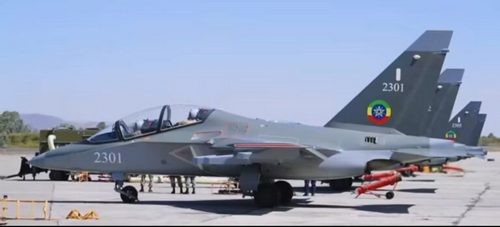
Also seen at Bishoftu Air Base for 90th anniversary celebrations were four Yak-130 jets. The tail numbers on the aircraft (2301, 2302, 2303, and 2306) suggested six have been delivered, possibly early in January.
The Yak-130 was designed to provide basic and advanced pilot training for Russian and foreign-made combat aircraft, including 4th+ and 5th generation fighters. The aircraft is fitted with an advanced glass cockpit and can carry 3 000 kg of weaponry.
The Yak-130s were most likely acquired as trainers for the Ethiopian Air Force's Flanker fleet, but they can also be used as ground attack aircraft. Ethiopia operates 18 Su-27P/SK and six Su-27UB Flankers acquired in the 1990s and two Su-30K Flankers (2401 and 2402) delivered in January 2024. It is believed these two were the aircraft returned by India. It has been speculated that another four Su-30Ks were to be delivered but it does not appear they have yet been.
Prime Minister Abiy Ahmed Ali, speaking on 24 January during the anniversary celebrations, said Ethiopia plans to double the capacity of its air force and transition to fifth generation combat aircraft by 2030, and the government has identified a clear plan, budget and funding sources accordingly (GDP has been growing at about 10% a year). He added that technology alone cannot build a capable force, highlighting the importance of human capital and professional training
The Prime Minister said Ethiopia has outgrown outdated perceptions of its military and strategic capacity. “Our door is open to our friends,” Abiy said. “But regarding our enemies, we will not sleep when it comes to protecting Ethiopia's honour, unity, and national interest.”
Meanwhile, Belarus's State Military-Industrial Committee recently reported that Belarusian unmanned aerial vehicle systems and electronic warfare equipment have undergone testing in Ethiopia and are already carrying out combat duty in the region.
Paramount Provides Humanitarian Support to Flood-Affected in Mozambique
www.defenceweb.co.za
Global aerospace and defence company Paramount has provided humanitarian assistance to flood-affected communities in Mozambique, deploying a rapid-response rescue boat supported by paramedics specialising in disaster medicine.
The deployment follows severe flooding that has left large areas of the country inaccessible, displacing communities and cutting off access to essential services. Paramount's rescue team has been operating on the ground for more than a week, the company said on 28 January, working in close coordination with the Mozambican Navy to support ongoing rescue and relief efforts.
The deployed rescue boat has been instrumental in ferrying stranded civilians and their belongings to safety, transporting medical equipment, delivering food and medical supplies, and evacuating injured and vulnerable patients from flood-isolated areas to accessible medical facilities, Paramount said, adding that its paramedics have also been providing on-site medical treatment for flood-related injuries and trauma.
Paramount is providing the assistance as part of its corporate social responsibility (CSR) programme, reflecting its long-standing partnership with Mozambique, where the group has supported the country's defence force for several years. It has delivered its Mwari aircraft and Marauder armoured personnel carriers to Mozambique's military, and supplied second hand equipment including Mi-8/17, Mi-24 and Gazelle helicopters as well as a Let-410 and a CN235 transport aircraft.
“This is about standing with the communities we serve when they need support most,” said a Paramount spokesperson. “Mozambique is a valued partner to Paramount and our commitment extends beyond defence capability to humanitarian responsibility. When disaster strikes, speed, experience and coordination save lives.”
Flooding has rendered many communities unreachable by road, significantly complicating rescue and medical response efforts. Paramount's maritime and medical capabilities have helped bridge this gap, enabling access to remote and isolated populations.
“Our teams are trained to operate in complex, high-pressure environments,” the Paramount spokesperson added. “Working alongside the Mozambican Navy, we have been able to reach cut-off areas, evacuate patients, deliver essential supplies and provide immediate medical care where it is most urgently needed.”
This deployment is not the first time Paramount has mobilised humanitarian assistance in support of customer countries and regional communities. During the height of the COVID-19 pandemic in 2020, the group donated food supplies to vulnerable communities in Mozambique, Ghana and Zambia, helping to alleviate food insecurity during extended lockdowns.
In 2019, Paramount also deployed its specialist K9 Search and Rescue Units to Eastern Zimbabwe following the devastation caused by Cyclone Idai. The units played a significant role in rescue and recovery operations in some of the hardest-hit areas before returning safely to South Africa.
As climate-related disasters become increasingly frequent and severe across Southern Africa, rapid response capabilities and cross-border cooperation remain critical to saving lives and accelerating recovery, Paramount said.
It reaffirmed its commitment to continuing its support efforts in Mozambique, while maintaining close coordination with local authorities to ensure assistance reaches those most in need.
Bristow Signs Launch Agreement with Electra to Secure First Delivery Slot for EL9 Aircraft
Electra and Bristow Group Inc. (NYSE: VTOL), the global leader in innovative and sustainable vertical flight solutions, signed a Pre-Delivery Payment (PDP) deposit agreement with binding terms and conditions aligned to the commercial aviation industry standard, subject to aircraft certification, securing the first delivery slot for Electra's EL9 Ultra Short hybrid-electric aircraft, capable of carrying nine passengers with baggage or 3,000 pounds of cargo for 330 nautical miles, and has a maximum ferry range of 1,100 nautical miles with IFR reserves.
By securing the earliest EL9 deliveries with its PDP agreement, Bristow confirms the Company's leadership role in shaping the future of Direct Aviation, positioning itself to offer customers unprecedented point-to-point access, dramatically reduced travel times, and entirely new opportunities for regional mobility.
Bristow and Electra have worked together for five years, starting with a pre-order agreement in 2021. The parties have now converted their pre-order LOI into a fixed agreement for five EL9 delivery slots, all to be delivered in the EL9's first year of production. By reserving these early slots, Bristow has secured unmatched early access to an aircraft set to redefine how people and goods move.
The PDP agreement includes option rights for Bristow to another 45 aircraft at the same fixed terms.
Bristow plans to deploy the EL9 across turnkey mobility solutions for corporate customers, premier destinations and resorts, major and regional airlines, and government agencies operating essential public service routes.
With more than seven decades of experience operating complex helicopter and fixed-wing missions for corporate and government customers around the world, Bristow has a proven history of integrating next-generation aviation technologies. The EL9 Ultra Short's ability to take off and land in just 150 feet will allow Bristow to open new transportation options, strengthening airline networks and significantly reducing travel times.
“Bristow has a long and respected track record of safely operating complex missions in some of the most demanding environments on earth,” said Marc Allen, CEO of Electra. “We are proud to welcome Bristow as an EL9 Launch Customer. By reserving five delivery slots in the EL9's first year of production, to include slot one, they have made a powerful statement of confidence in Electra, our EL9 aircraft, and the future of Direct Aviation. We could not imagine a stronger or more capable partner to lead the introduction of this transformative mode of advanced air mobility that will give communities, travelers, and airlines access to fast, flexible, and sustainable transportation.”
“Electra's EL9 fundamentally changes what regional air mobility can be,” said Dave Stepanek, Bristow Executive Vice President, Chief Transformation Officer. “Its ultra-short performance, quiet operation, and lower operating costs create opportunities that simply do not exist with today's aircraft. Securing delivery slot one and reserving delivery slots in the first year of production ensures Bristow will lead this new industry and bring advanced air mobility capabilities to our customers first. We are confident that with this order we will extend our legacy of innovation and deliver new levels of access, speed, and sustainability to our customers across the many markets we serve.”
Electra's Direct Aviation model uses Ultra Short aircraft to unlock thousands of new Ultra Short access points - including fields, parking lots, and underutilized runways - bringing air travel closer to where people live, work, and play. By pairing practical infrastructure with transformative capability, Direct Aviation enables trips that were previously impractical or impossible and expands economic opportunity to communities of every size.
Horizon Aircraft Unveils Key Advances for Full-Scale Cavorite X7
New Horizon Aircraft Ltd. (NASDAQ:HOVR), doing business as Horizon Aircraft ("Horizon Aircraft" or the "Company"), an advanced aerospace engineering company and developer of one of the world's first hybrid-electric VTOL (Vertical Take-Off and Landing) aircraft, shares exciting technical updates on the Cavorite X7 that elevate safety, aerodynamics, and cruise performance.
Following the successful transition flight of its large-scale prototype in May 2025 that validated the Company's patented fan-in-wing technology, Horizon Aircraft has been designing and building its full-scale hybrid-electric VTOL aircraft. The Cavorite X7's refined design has been a collaboration between Horizon Aircraft's highly skilled engineering team and internationally acclaimed mobility designer, Andrea Mocellin, resulting in a design that further enhances safety while optimizing performance.
Vertical Lift Fans - The aircraft features a total of 12 vertical lift fans: five in each wing and one in each canard. Replacing four smaller canard fans with two wing-size fans standardizes all 12 units, improving manufacturing efficiency, increasing performance, and simplifying maintenance. This update was achieved without compromising safety margins, enabled by a redundant, dual-motor architecture powering each lift fan.
Aerodynamic Surface Improvements - The canard and tails have been reprofiled to lower drag, improve cruise efficiency and enhance stability.
Enhanced Passenger Experience - The Cavorite X7's cabin has been slightly extended and its windows redesigned to provide more legroom and improved sightlines, creating a more comfortable and premium experience for passengers.
Horizon Aircraft Co-Founder and CEO Brandon Robinson stated, "These technical updates are a result of our world-class engineering team's ability to effectively enhance the performance of our aircraft. We remain committed to building one of the safest, toughest, and most performing modern VTOL aircraft, and these updates further advance that mission."
France orders Airbus VSR700 un-crewed aerial system
The French Armament General Directorate (DGA) has awarded a contract to Airbus Helicopters and Naval Group for the production of six VSR700 un-crewed aerial systems. The VSR700s will be operated from 2028 by the French Navy.
“We are honoured that the French Ministry for the Armed Forces has decided to launch the next phase of the VSR700 programme with serial production for France and future export customers within the frame of the agreement signed at the Paris Air Show in 2025. Airbus Helicopters is fully committed to delivering this much-needed operational capability. Our teams are focused on providing the French Navy with a reliable, high-performance tool that enhances their sovereignty and mission success,” said Bruno Even, CEO of Airbus Helicopters. “To ensure the success of this next chapter, we have established a new industrial setup specifically designed for serial production. This structure allows us to adapt to the specificities of the UAS market and to scale efficiently while maintaining the highest standards of aeronautical safety and performance,” he added
The VSR700 will be delivered in an Intelligence, Surveillance and Reconnaissance (ISR) configuration comprising a surveillance radar, an electro optical system and an AIS (Automatic Identification System) receiver. Naval Group will ensure its integration into the overall architecture of the ships and its interconnection with the combat system thanks to the Steeris® Mission System.
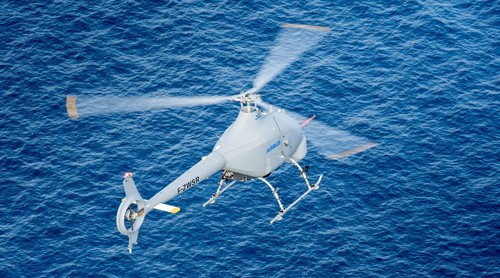
The VSR700 is a dual use un-crewed aerial system, based on the crewed Cabri G2 from Hélicoptères Guimbal. The naval military version was developed and tested in the frame of the French Navy and DGA SDAM (Système de drone aérien de la Marine) programme, in cooperation with Naval Group. The VSR700 and its mission system have been extensively tested over land and at sea. Often deployed in complement of a crewed helicopter, the VSR700 can be used to extend a vessel's intelligence gathering capabilities and conduct long endurance surveillance missions.
The VSR700 can accommodate a variety of long-range, high-performance sensors. Although it will be used in an ISR configuration by the French Navy, the VSR700 is a multirole UAS that can be used for a variety of missions including logistics and armed scout both in a maritime and a land environment. It can also be used for civil missions including firefighting and disaster relief. Airbus has also demonstrated the VSR700's ability to team with crewed helicopters using the HTeaming solution.
Boeing: Indian, South Asian Airlines will Need Nearly 3,300 New Airplanes by 2044
India and South Asia's passenger air traffic will rise an average of 7% annually over the next 20 years, spurred by a growing middle class, economic growth and airport and connectivity investments, Boeing [NYSE: BA] said today. That demand for air travel means airlines will need nearly 3,300 new airplanes by 2044 as projected in the company's Commercial Market Outlook (CMO) for South Asia.
Single-aisle jets will account for nearly 90% of these projected deliveries as airlines look to boost network flexibility on fast-growing short- and medium-haul routes.
Accounting for growth and replacement, the Indian and South Asian region's fleet will grow from 795 to 2,925 airplanes in two decades - a nearly four-fold increase over that time. Domestic travel that connects India will underpin this expansion, supported by a continuing shift from rail to air and investments in the country's airport infrastructure.
“As air travel becomes more integral to how people and goods move in India and South Asia, airlines will strengthen networks, scale fleets and invest in services and technical personnel to support long-term growth,” said Ashwin Naidu, Boeing managing director of Commercial Marketing, Eurasia and Indian Subcontinent. “More efficient, versatile airplanes will enable robust growth opportunities for the region's established and emerging airlines.”
Indian and South Asian airlines are also projected to expand and diversify their long-haul networks as India grows as a key hub for international passenger and cargo traffic. The South Asia region's widebody fleet will more than triple by 2044 as carriers enable millions of Indian and South Asian passengers to travel to international markets including the Middle East, Europe and North America.
In the cargo market, high-tech manufacturing growth in India and the increasing role of e-commerce will boost the need for more freighter airplanes. The South Asia region's fleet of new and converted freighters is expected to grow five times its current size over the next two decades to support rising air cargo demand.
To support the expected fleet growth, investment in the South Asia region's industry will require more than $195 billion in aviation services, including maintenance, repair and modifications, digital services and training. Boeing projects the India and South Asia aviation industry will also need approximately 141,000 new professionals, including about 45,000 pilots, 45,000 technicians and 51,000 cabin crew, over the next two decades.
3 February 1985
First flight of the Atlas XH-1 Alpha, a South African prototype attack helicopter, used as a concept demonstrator for the then-planned Rooivalk project.
The Atlas XH-1 Alpha was developed by Atlas Aviation (now Denel) of South Africa, from an Aérospatiale Alouette III airframe, retaining that helicopter's engine and dynamic components, but replacing the original cockpit with a stepped tandem one, adding a 20 mm cannon under the chin and converting the undercarriage to tail-dragger configuration.
The XH-1 first flew on 3 February 1985 and soon embarked on a rigorous flight test program to examine the feasibility of a dedicated attack helicopter in southern African conditions. The results were ultimately good enough to convince Atlas and the South African Air Force to go ahead with the development of a dedicated attack helicopter. The XH-1 and Rooivalk are completely different aircraft and share no components. The Rooivalk was developed from the later XH-2 prototype.
The sole XH-1 was retired sometime in the late 1980s and was handed over to the South African Air Force Museum, where it is on display.
Niger, Niamey Airport (NIM/DRRN): An Air Côte d'Ivoire Airbus A319-112, TU-TRE, as well as an Asky Airlines, Boeing 737 MAX 8 operated on behalf of Ethiopian Airline were struck by gunfire while parked overnight at NIM during a night-time attack at Niamey Airport (NIM) by IS-Sahel jihadist militants
India, Baramati Airport, Baramati, Pune district, Maharashtra: A Learjet 45XR, VT-SSK operated by VSR Ventures Pvt Ltd crashed short of the threshold while attempting a second approach to runway 11 at Baramati Airport. The five occupants perished and the aircraft was destroyed. One of the passengers was the Maharashtra deputy chief minister Ajit Pawar. The flight took off from Mumbai (BOM) at 08:10 local time, bound for Baramati Airport. VT-SSK first came in contact with Baramati at 08:18. The aircraft's next call was at 30 NM inbound to Baramati and they were released by Pune approach. They were advised to descend in Visual Meteorological conditions at the pilot's discretion. The crew enquired about the winds and visibility and they were informed that the winds were calm and visibility was around 3000 meters. Next the aircraft reported on the final approach of Runway 11 but they did not have the runway in sight. They initiated a go-around in the first approach. The flight circled for another approach of runway 11. They were asked to report runway in sight. They replied "runway is currently not in sight, will call when runway is in sight". After a few seconds they reported that the runway is in sight. The aircraft was cleared to land on runway 11 at 08:43, however, they did not give a readback of the landing clearance. Next, the controller saw the flames around the threshold of runway 11 at 08:44. The wreckage of the aircraft was located on the left side of the runway abeam threshold R/W 11. AAIB has taken over the investigation, DG, AAIB is reaching the accident site for investigation. Further details of the same as and when available will be shared. Baramati is an uncontrolled airfield and traffic information is provided by the instructors/Pilot from the Flying training Organisations at Baramati. It has a single runway (11-29), measuring 5500 x 100 feet with turning pads at both ends. At the end of runway 29, there is a dropoff, immediately after the runway 11 threshold.
AirVenture Oshkosh 2024 Heavy Metal at Boeing Plaza 618